3 min read

From reporting to predictive analytics

From reporting to predictive analytics

How Swiss companies extract real value from their data

Data creates transparency. But while reporting only makes past developments visible, competitive advantages emerge when data is actively used for decision-making, forecasting, and automation. This article shows how companies can successfully move from reporting to predictive analytics. 

70
%

 AI projects fail due to poor data quality and lack of integration

10
%

 of companies in Switzerland have a consistent data structure

Swiss companies are currently investing heavily in AI, analytics and automation – even though the underlying foundations are often still missing. Even in digitally advanced industries such as insurance, around 70% of AI projects fail today due to poor data quality and lack of integration, while in banking the figure is 61% (Netzwoche). Overall, only around one in ten companies in Switzerland has a consistent data structure (Swiss AI Report 2025).

However, modern analytics or AI solutions alone do not create value if the underlying data is incomplete, inconsistent, or inaccessible. In other words: poor data does not only lead to poor decisions – it already prevents reliable analysis and meaningful reporting.


How far along is your company on its journey toward data-driven decision-making?

Take our Business & Process Automation Maturity-Assessment now and discover the next steps that make sense for your company.

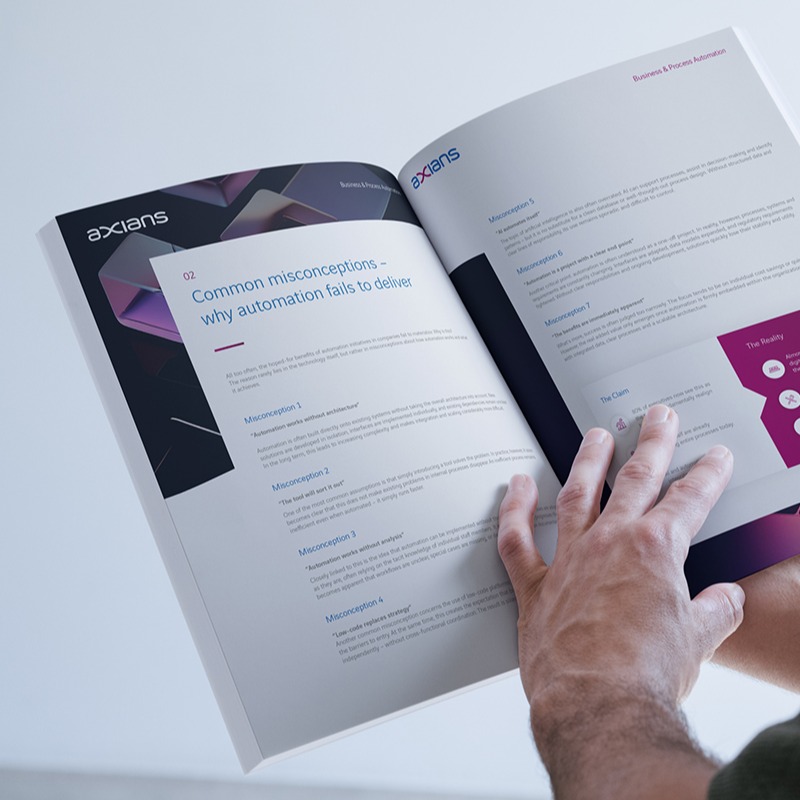
axians-mockup-whitepaper-business-process-automation-2-englisch


Reporting shows what has happened, but does not yet enable control

We often observe that even when data is available and usable, companies still tend to rely primarily on retrospective analysis rather than using it for operational steering and AI-driven, forward-looking decision-making. Dashboards, KPI systems, and automated reports may visualize trends and improve access to information, but they do not show what will become relevant next.

In practice, this also leads to different interpretations of the same data. For example, when sales, operations, and finance work with different data states and forecasts need to be consolidated manually, decisions are delayed not because data is missing, but because there is no shared, end-to-end data foundation. The solution therefore lies in a structured, integrated approach to data across system and process boundaries.

From reporting to predictive: the next maturity level of data-driven companies

Companies that successfully use data for steering, planning, and automation typically develop their data capabilities in several stages:

Descriptive Analytics – What happened?

Data is visualized and analyzed, for example through dashboards, reports, or KPI systems. Companies gain transparency into past developments and current performance indicators. A retail company, for instance, can use dashboards to identify which products sold particularly well over the past weeks or which locations are experiencing declining sales.

Diagnostic Analytics – Why did it happen?

Relationships and root causes are analyzed, and patterns, anomalies, and influencing factors within processes and data are identified. An insurance company might analyze why processing times for certain claims are significantly higher than average. By linking process and case data, patterns can be uncovered – such as specific case types, process breaks, or missing information that cause delays.

Predictive Analytics – What is likely to happen?

Historical and current data are used to forecast future developments. A manufacturing company, for example, can plan maintenance windows early before machines fail. In retail, demand trends can be predicted more accurately to better manage inventory and supply chains.

AI & intelligent automation – What action makes sense?

Systems actively support decision-making, automate processes, and respond to defined events or predictions in real time. For example, a logistics company can detect delivery delays early and automatically suggest alternative routes or time slots. At the same time, affected customers are informed and internal processes are adjusted before operational issues occur.

In the final two stages in particular, a noticeable impact emerges in day-to-day operations: faster decisions, improved planning reliability, and processes that can be actively controlled and scaled.

How to use your data effectively 

For companies to successfully move from reporting to predictive analytics and AI, more is required than additional tools or isolated data projects. What is essential is a solid foundation: high-quality, integrated data sources instead of data silos, clear processes, a scalable architecture, and well-defined governance structures. Only when data is consistent, accessible, and usable across systems can it support reliable analytics, operational decision-making, and automated processes.

This is exactly where Axians comes in. We support Swiss companies in taking a holistic approach to bringing together their data landscapes, business applications, and automation – from integration and data & analytics to scalable platform and AI solutions. The focus is on solutions that work in day-to-day operations and create measurable impact.