1 min read
Why Structure Determines the Productivity of Digital Workspaces
Today’s digital workplace is much more than a collection of technologies. It influences team collaboration, operational efficiency, and an organization’s ability to navigate change. Yet experience shows that even the most advanced tools are not enough on their own to create a truly productive digital workplace.
Around 60% of Switzerland’s workforce can work remotely on a regular basis (Cisco Study 2025). This presents CIOs and IT leaders with a significant challenge: providing hybrid employees with a Digital Workspace that enables them to work as efficiently as possible.
In this context, productivity is not determined by the introduction of additional technologies. What matters is how well the solutions in use are structured, integrated, and adopted in day-to-day work.
When Platforms Grow, but Processes Don’t Scale
Our experience working with organizations across Switzerland shows that Digital Workspaces often evolve organically over many years. What is frequently missing, however, is an overarching strategy that brings together processes, responsibilities, and the user experience.
In our day-to-day project work with Swiss companies, we regularly see the following challenges:
- Information is scattered across multiple systems
- Teams rely on multiple communication channels in parallel
- Employees constantly switch between applications
- Processes vary across departments
- Shadow IT emerges outside defined standards
The impact extends far beyond individual employees’ workplaces. Support efforts and ticket volumes also increase for IT teams, processes become slower, and the adoption of new technologies is limited.
At the same time, our experience shows that it is becoming increasingly challenging for organizations to reliably manage security, governance, and productivity in such a complex work environment.
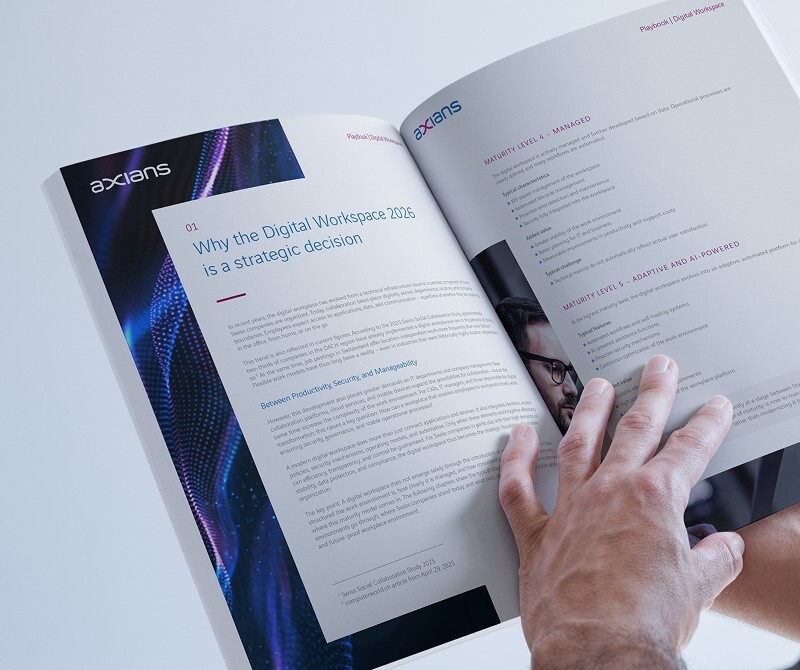
How well structured is your Digital Workspace today? Assess the maturity of your digital work environment with our self-check and uncover potential areas for improvement.

The Digital Workspace as an Integrated Operating Model
A productive digital workspace is not created by adding more features or additional platforms. What matters is how well applications, processes, security mechanisms, and workflows work together. This is exactly where a structured approach comes in.
This includes:
- clear governance and defined responsibilities
- standardized platforms and consistent processes
- integrated security and identity concepts
- automated operational and support workflows
- a work environment aligned with employees’ actual needs
For organizations, this also requires a shift in perspective: moving away from isolated tool initiatives toward a digital workspace that is understood as a continuously managed system.
The Next Step Toward a Structured Digital Workspace with Axians
Axians supports you in building exactly this structure—from modernizing existing workplace environments and strengthening endpoint and identity management to establishing governance, automation, and managed services. We combine local presence and a deep understanding of Switzerland’s regulatory requirements with the experience of an internationally connected ICT partner.

Read More